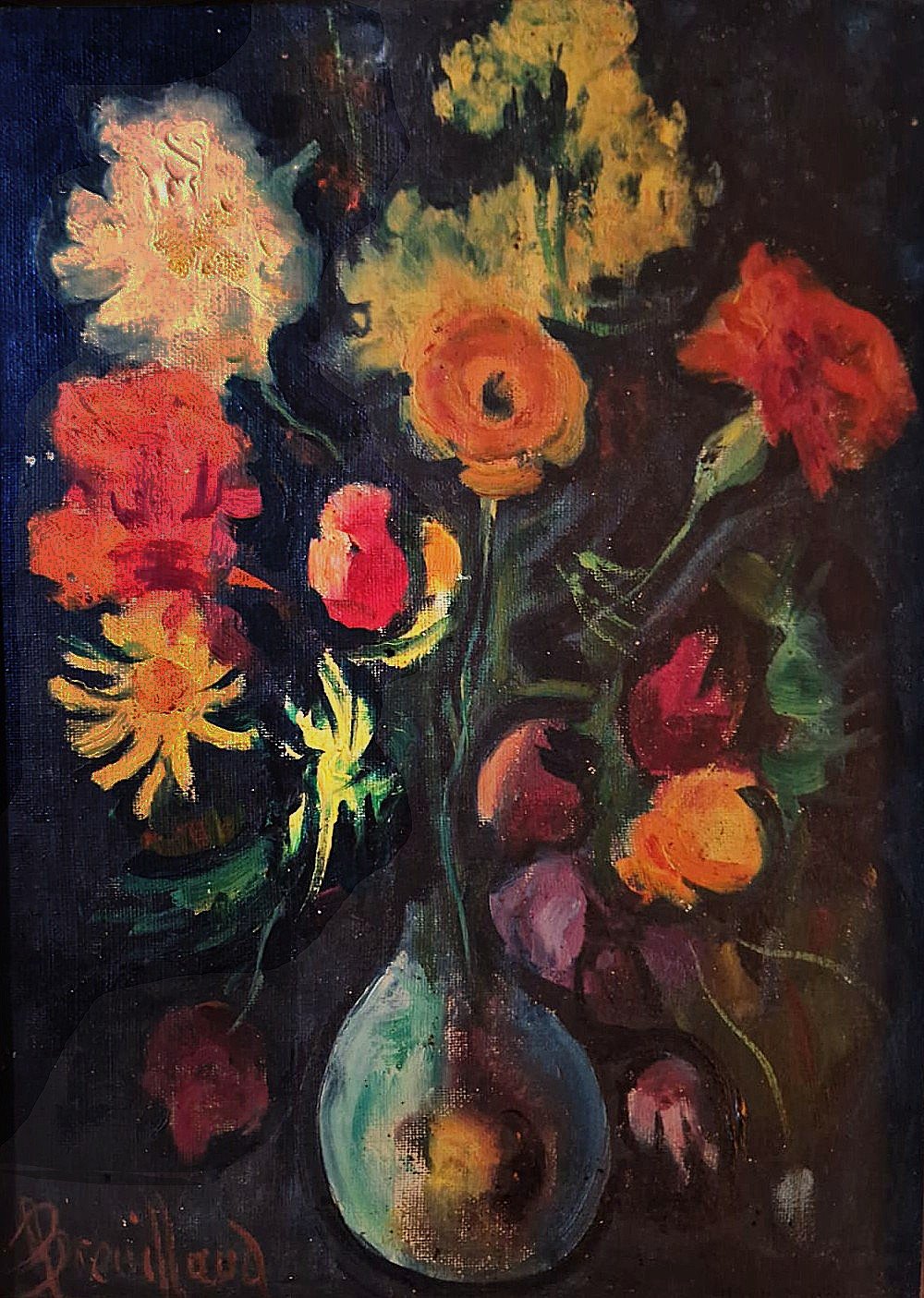
Technical information
- Title : Nocturnal Bouquet
- Date : c. 1964
- Technique : Oil on canvas
- Dimensions : 41 × 33 cm
- Location : Private collection
Biographical / historical context
This work belongs to the small group of bouquets painted by André Breuillaud around 1964, at a moment when his pictorial language was mainly concentrated on organic forms, inner envelopes and increasingly autonomous compositions. In this context, the bouquet appears as a rare but significant parenthesis: not a conventional return to still life, but a field of experiment in which colour, light and matter are tested within an immediately legible figurative framework.
The indication that the work was executed in Caromb is important. The floral motif takes on an intimate, almost domestic dimension, far removed from the large organic systems of the same period. Breuillaud nevertheless transposes the same concerns into it: making form arise from matter, organising coloured masses around luminous nuclei, and transforming a traditional subject into a field of pictorial tension.
Formal / stylistic description
The vertical, tightly framed composition presents a blue-green vase in the lower part of the canvas, from which a few flowers emerge freely against a very dark background. Unlike the more abundant bouquets of the same year, the work does not seek decorative profusion. It favours a sparer, almost nocturnal structure in which each corolla becomes an isolated focus of light.
The black-brown ground absorbs much of the space and gives the painting a muted depth. The flowers — red, yellow, orange, mauve and white — appear in direct, sometimes impasted touches, like coloured bursts detached from the darkness. The large red flower at left, the orange corolla at the centre and the red mass at the right edge organise an intense chromatic triangle, while the yellows and whites animate the surface through rapid flashes of light.
The vase, treated in milky blue and turquoise tones, anchors the whole. Its rounded, slightly translucent form contrasts with the verticality of the stems, some of which are reduced to thin dark lines. The bouquet does not unfold as a descriptive ensemble: it is fragmented, open, almost suspended. The pictorial matter reveals reworkings, rubbed passages and darker areas where the canvas shows through, reinforcing the sense of an apparition rather than of a posed still life.
Comparative analysis / related works
Comparison with the two other known bouquets of 1964 makes it possible to situate this canvas precisely. In relation to AB-MP3-1964-010, where the bouquet spreads horizontally across a deep blue ground and forms a dense floral mass, AB-MP3-1964-009 adopts a more vertical, more scattered and more dramatic formula. The motif does not form a continuous crown: it is distributed as luminous points, within an economy of means that makes each patch of colour more active.
Set against AB-MP3-1964-011, whose light ground opens the space and gives the bouquet a more immediate sense of breathing, this work occupies the opposite pole: it tightens the image, darkens the field and transforms the bouquet into a nocturnal emergence. The floral subject becomes less a celebration of colour than an experiment in contrast between apparition and withdrawal, brilliance and absorption.
This rarer and more condensed character gives the canvas a particular place within the corpus. It clearly belongs to the same group of floral still lifes, but it offers their most secret aspect: a non-expansive, almost interior bouquet, in which colour does not merely describe the flowers but struggles against the dark depth surrounding them. In this respect, the work links the figurative parenthesis of the bouquet to Breuillaud's broader research into the birth of form within an autonomous pictorial space.
Justification of dating and attribution
The dating to around 1964 is consistent with the work's evident proximity to the two bouquets from the same year, both in subject and in palette and freedom of handling. The same chromatic directness, the same simplification of floral forms and the same supple pictorial matter are present, alternating localised impasto with more absorbed passages.
The attribution to André Breuillaud is supported by the signature at the lower left and by the stylistic coherence with this moment of the MP3 period: freedom of contour, refusal of strict naturalism, intensity of contrasts, and transformation of a traditional motif into a composition of light and matter. The fact that the work was executed in Caromb confirms its belonging to an intimate context of production, close to the other floral experiments of 1964.
Provenance / exhibitions / publications
Current provenance: private collection.
Signed lower left; executed in Caromb.
© Bruno Restout - Catalogue raisonné André Breuillaud