Technical information
- Title : Le Graveyron
- Date : c. 1949
- Technique : Oil on cardboard
- Dimensions : Unknown
- Location : Private collection
Biographical / historical context
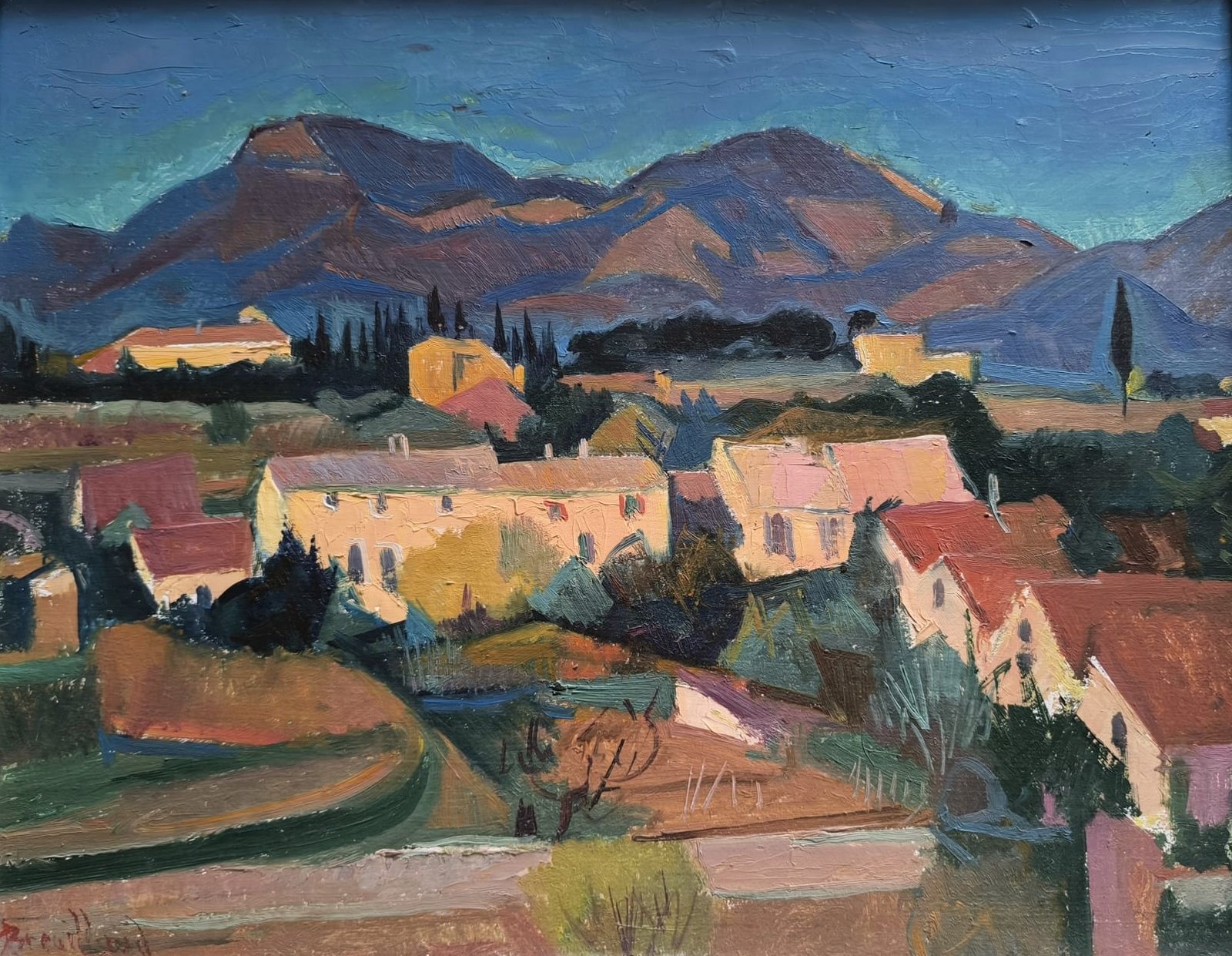
This view of Graveyron, identified on the reverse as “surroundings of Carpentras, Le Graveyron”, belongs to the group of Provençal landscapes to which Breuillaud returned with particular intensity in the late 1940s. In these works, the artist observes villages, isolated farmhouses, lines of cypresses and the reliefs of the Comtat Venaissin not as merely descriptive motifs, but as plastic structures capable of organising colour and light.
Around 1949, the Provençal landscape became for Breuillaud a field of synthesis. After the more narrative scenes of the immediate post-war period, he here concentrates his vocabulary around a construction by planes: houses, roofs, cultivated plots, hedges, hills and sky are treated as coordinated masses. The inscription on the reverse precisely fixes the site, while the label of the Salon de l’Enclave, Valréas, 1956, indicates that the work was shown or presented in a regional Vaucluse context, confirming its place within the artist’s Provençal corpus.
Formal / stylistic description
The composition adopts a slightly elevated viewpoint over a group of houses and gardens set before a range of blue and violet reliefs. The foreground is built through a succession of paths, plots and roofs that form a warm horizontal base. At the centre, the light-coloured façades, in yellows and ochres, catch the light; they are punctuated by small dark openings and by red, pink or mauve roofs, whose simple volumes give the village an almost architectural presence.
The middle ground is animated by dark vegetal masses: hedges, trees and cypresses stand out as vertical or compact silhouettes. These forms act as a counterweight to the houses and lead the eye towards the reliefs in the background. The mountains are not rendered topographically: they are broken down into broad planes of blue, brown, violet and mauve, with orange highlights marking the ridges and shifts of light.
The brushwork remains visible, at times nervous, laid down in light impasto and rubbed passages. It gives the oil on cardboard a direct vibration without sacrificing the legibility of the motif. The broadly open turquoise-blue sky intensifies the sense of depth, while also contributing to the decorative flattening of the whole: the scene thus oscillates between observed view and coloured construction. The signature is visible at the lower left.
Comparative analysis / related works
The work should be compared with AB-PR1-1949-001, View of Le Barroux at Caromb, which belongs to the same moment and to the same group of Provençal landscapes. The two compositions share an organisation by registers: an inhabited or cultivated foreground, dark masses of cypresses and trees, and distant reliefs treated as coloured bands. In both cases, Breuillaud does not seek a picturesque transcription of the site; he transforms the landscape into an architecture of planes and a chromatic equilibrium.
Le Graveyron, however, is distinguished by a closer and more luminous relationship to the motif. Whereas View of Le Barroux at Caromb emphasises distance, the perched village and a more crepuscular atmosphere, this work places the gaze at the level of a more immediately inhabited village: houses, gardens and roofs occupy the front of the scene. The palette is also clearer and more Mediterranean, with yellow façades, red roofs and a turquoise sky that lighten the whole.
This work anticipates the more structured Provençal landscapes of the early 1950s, in which Breuillaud would further accentuate the simplification of volumes and the compartmentalisation of planes. It nevertheless retains a freedom of touch characteristic of the late 1940s: the construction is already firm, but the material surface remains sensitive, vibrant and attentive to variations of light.
Justification of dating and attribution
The dating to around 1949 is consistent with the syntax of the PR1 landscapes: a Provençal palette opposing ochres, reds and deep blues; simplification of built volumes; reliefs constructed in superimposed planes; and the structuring role of cypresses and vegetal masses. The comparison with AB-PR1-1949-001 reinforces this proposal: the same moment of research, the same interest in the villages of the Provençal foothills, and the same balance between observation of the site and synthetic construction.
The attribution to André Breuillaud is supported by the signature visible at the lower left, by the inscription on the reverse situating the work, and by its stylistic coherence with the Provençal corpus of the late 1940s. The label of the Salon de l’Enclave, Valréas, 1956, also constitutes an important documentary element in the history of the work.
Provenance / exhibitions / publications
Current location: private collection.
Inscription on the reverse: “surroundings of Carpentras, Le Graveyron”.
Label on the reverse: Salon de l’Enclave, 1956, Valréas (Vaucluse).
© Bruno Restout - Catalogue raisonné André Breuillaud