Technical information
- Title : L’Arinier at Caromb
- Date : c. 1949
- Technique : Oil on canvas
- Dimensions : 33 × 41 cm
- Location : Private collection
- Signature / inscription : signed lower left. Reverse: “Quartier de L’Arinier à Caromb”.
Biographical / historical context
This view of the L’Arinier district in Caromb belongs to the Provençal moment of the late 1940s, when Breuillaud returned insistently to the motifs of the foothills of Mont Ventoux: terraced villages, red or ochre earth, olive trees, cypresses, and bluish or mauve reliefs. Landscape is no longer merely observed from a natural viewpoint; it becomes a field of construction in which the artist organises masses, value contrasts and chromatic harmonies.
The inscription on the reverse, “Quartier de L’Arinier à Caromb”, gives the work significant documentary value. It locates the motif precisely within the territory of Caromb and confirms the role of this area as a place of observation and experiment. At this stage, Breuillaud is still working within a legible landscape painting, but the image already announces the more architectured solutions of the early 1950s, when hills, fields and villages would increasingly be reconstructed through coloured planes.
Formal / stylistic description
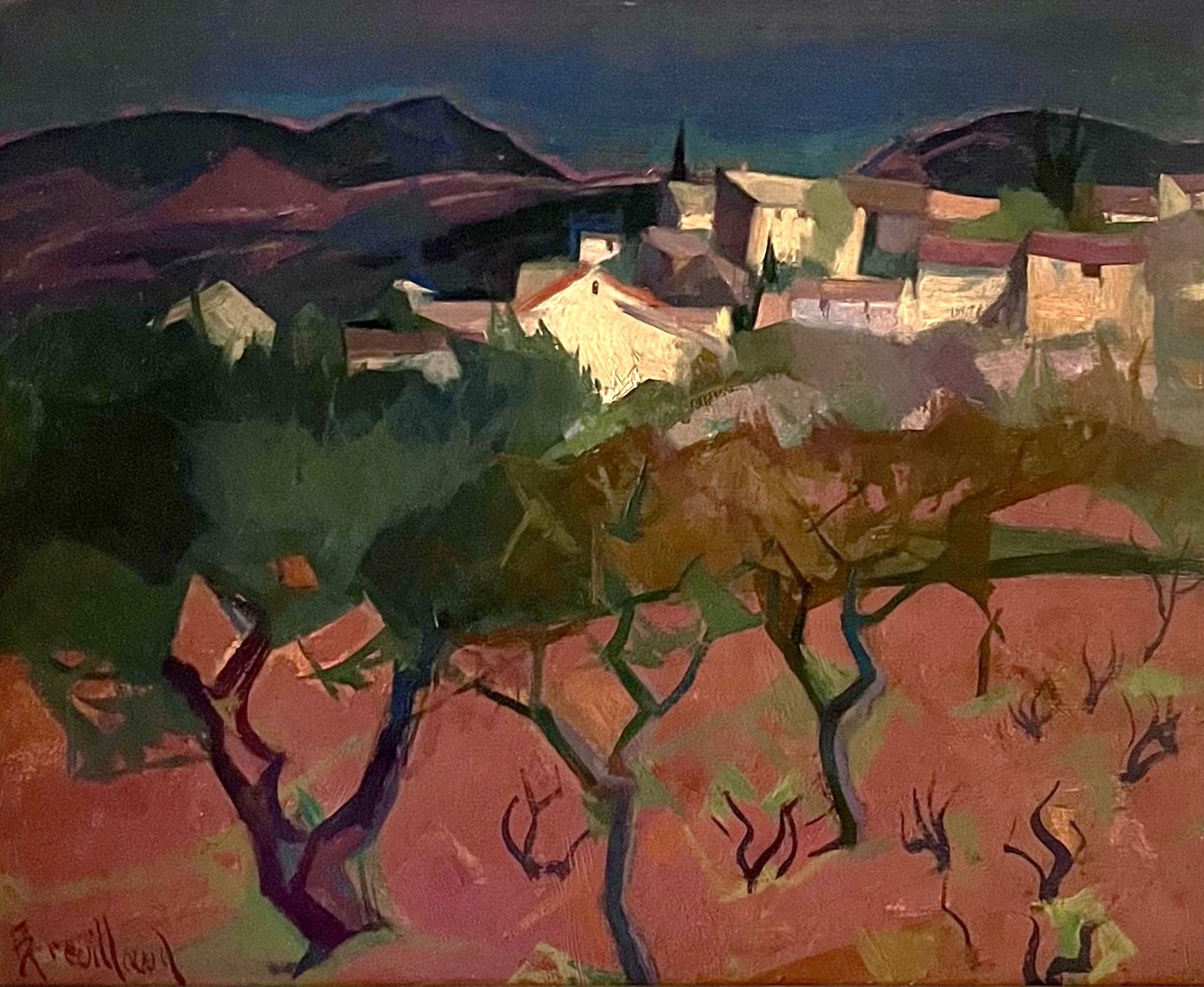
The composition adopts a horizontal format and is built through broad superimposed registers. In the foreground, red and pinkish earth is crossed by the dark silhouettes of olive trees, whose trunks and branches form a graphic network. This first vegetal screen does not close the scene; on the contrary, it acts as a filter, allowing the village to appear in the middle ground.
The houses of Caromb are treated as clear, almost luminous volumes set on the slope. The white or pale yellow façade near the centre acts as a focus of light and immediately draws the eye. Around it, red roofs, cream-coloured walls, dark green masses and violet planes organise a compact architecture in which descriptive detail gives way to the overall structure.
In the background, the reliefs unfold in broad bands of deep blue, mauve and purple beneath a dense, almost crepuscular sky. The opposition between the warm earth of the foreground, the pale houses and the cool distant hills provides the painting’s principal tension. The brushwork remains visible, at times rapid, but it is already disciplined by the construction: each coloured zone contributes to the interlocking of the whole.
Comparative analysis / related works
The work is in direct dialogue with AB-PR1-1949-001, View of Le Barroux at Caromb, another Provençal landscape from the same sequence. In both cases, Breuillaud favours a view constructed through registers: vegetal or cultivated foregrounds, pale houses at the centre, and bluish reliefs in the distance. One also finds the role of cypresses and dark masses, which punctuate the space and give the landscape a vertical framework.
However, L’Arinier at Caromb appears more frontal and more strongly chromatic. Where View of Le Barroux at Caromb retains a colder, almost nocturnal atmosphere, this canvas emphasises the warmth of the earth and the vibration of the illuminated houses. The landscape thus moves closer to a more synthetic syntax: the olive trees in the foreground, reduced to nervous trunks and green masses, are no longer merely natural elements, but plastic signs that structure the pictorial field.
Through its balance between the legibility of place and the simplification of planes, this work forms an important milestone between the atmospheric landscapes of the post-war years and the more geometrised vocabulary of the PR2 period. It shows Breuillaud at the moment when the Caromb motif becomes a true laboratory of composition.
Justification of dating and attribution
The dating to around 1949 is consistent with the construction of the landscape, still attached to the observed motif but already oriented towards a strong organisation by coloured planes. The contrasts of red earth, deep greens, pale houses and blue-mauve reliefs correspond to Breuillaud’s Provençal research at the end of the PR1 period, just before the accentuation of facets and chromatic breaks around 1950.
The attribution to André Breuillaud is confirmed by the painted signature at the lower left and by the stylistic coherence with contemporary Caromb landscapes: simplification of built volumes, the structuring role of olive trees, the tension between warm light and cooled distance, and the construction of space through interlocking masses. The inscription on the reverse precisely locates the motif and reinforces the work’s anchoring within the artist’s Provençal corpus.
Provenance / exhibitions / publications
Current location: private collection.
Inscription on the reverse: “Quartier de L’Arinier à Caromb”.
© Bruno Restout - Catalogue raisonné André Breuillaud