Technical information
- Title : Adoration of the Magi
- Date : c. 1950
- Technique : Oil on canvas
- Dimensions : Unknown
- Location : Private collection
Biographical / historical context
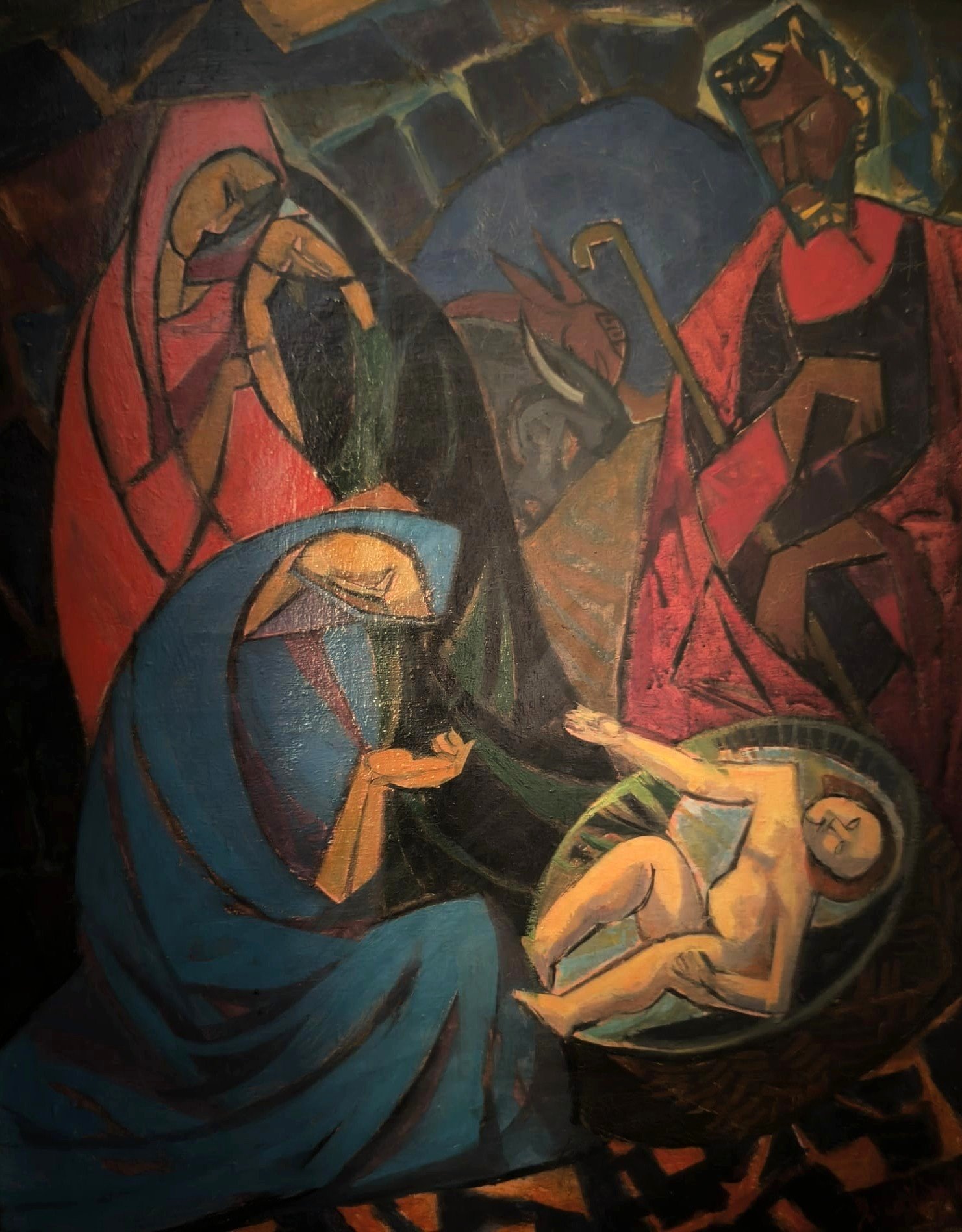
Adoration of the Magi belongs to the very small group of religious compositions executed by André Breuillaud around 1950. Within the corpus currently known, this date corresponds to a rare inflection: the artist transposes the vocabulary of the PR1 period, marked by angular silhouettes, coloured planes and the tension of contour, into an explicitly sacred iconography.
The work should be considered alongside Christ on the Cross and Descent from the Cross, which bear witness to the same moment of research into a modernised religious painting, far removed from any academic form of reconstruction.
The inscription on the reverse, indicating the title and signature, together with the note that the work was executed in Caromb, gives this canvas a particular place. The biblical subject is not treated as a historical scene set in an Oriental décor: rather, it seems to be reconstructed within a dark, dense interior space, where the episode of the Nativity becomes a theatre of forms. Here, Caromb appears less as a descriptive location than as the setting of a studio and a plastic inquiry, in which Breuillaud reinterprets sacred tradition through a personal syntax, nourished by post-Cubist simplification and expressive gravity.
Formal / stylistic description
The vertical composition is dominated by a tight, almost circular organisation around the Child, placed in a basket at the right foreground. The pale body of the newborn, rendered through simplified planes of ivory and ochre, concentrates the brightest light in the canvas. Around him are arranged the figures of the Adoration: in the left foreground, a woman draped in blue bends forward in a gesture of offering; to the left, a large red figure leans in, the face reduced to a construction of facets; to the right, a standing Magus, dressed in red and brown, holds a vertical staff that echoes the uprightness of his body. A third woman in dark clothing closes the circle of female figures. At the centre, in the depth of the composition, the donkey and the ox appear as discreet signs of the manger.
The space is not constructed according to naturalistic perspective. It is composed through the interlocking of planes: dark areas of background, fragments of blue, brown and green, architectural diagonals and black contours that divide the surface like the leading of stained glass. The scene thus possesses a nocturnal, contemplative dimension. Blacks and browns envelop the figures, while deep blues, muted reds and luminous ochres distribute the dramatic accents.
Breuillaud does not seek narrative anecdote here. The faces are schematised, almost masked; hands, draperies and liturgical objects are reduced to signs. The strength of the work lies in this condensation: the Adoration becomes less a narrated episode than a device of presence, in which each figure is a coloured mass oriented towards the luminous focus of the Child. The energetic handling of contours, the fragmentation of bodies and the dark density of the paint surface place the canvas within a strongly constructed form of sacred painting, at once popular in subject and modern in language.
Comparative analysis / related works
The work is in direct dialogue with Christ on the Cross, dated 1950, in which Breuillaud already organises a sacred subject around a monumental axis and a fragmented background. Both works reveal the same search for inward frontality, the same opposition between deep blues and incandescent reds, and the same use of dark contours to give the figures a stained-glass presence. However, where Christ on the Cross concentrates tension on the verticality of the cross and on the single figure of the Crucified, Adoration of the Magi unfolds a more enveloping scene: the centre is no longer an axis of suffering, but a luminous focus towards which the figures converge.
The comparison with Descent from the Cross is equally illuminating. The two paintings share a choral dramaturgy: several figures surround a pale body placed in the foreground, whose whiteness concentrates the emotional force of the scene. In Descent from the Cross, the body of Christ is extended horizontally, already separated from the living world; in Adoration of the Magi, by contrast, the body of the Child is contained, protected, almost inscribed within a cradle of forms. The two compositions thus function as two poles of an implicit cycle: birth and death, apparition and lamentation, treated with the same economy of signs and the same desire for modern monumentality.
Within the first Provence period (PR1), this canvas stands out for its more intimate and nocturnal character. It takes up the angularity of the compositions of the late 1940s, but places it at the service of a climate of contemplation rather than movement. The figures do not dance or walk: they gather, bow and converge. This restraint gives the work a singular place within the religious corpus of 1950, between popular icon, post-Cubist construction and pictorial meditation on the sacred.
Justification of dating and attribution
The dating around 1950 is consistent with the full range of stylistic features: geometrisation of bodies, assertive brown or black contours, fragmentation of space into coloured planes, and an intense palette dominated by blues, dark reds, ochres and browns. These elements correspond to Breuillaud’s research at the hinge of the years 1948–1951, during the PR1 period.
The comparison with Christ on the Cross and Descent from the Cross reinforces this dating: the same transposition of a religious subject into a modern language, the same expressive reduction of faces, and the same architectonic density of composition. The mention of the title and signature on the reverse, together with the indication that the work was executed in Caromb, support the attribution to André Breuillaud and make it possible to associate this work with the very specific moment when the artist explored sacred iconography in an exceptional way.
Provenance / exhibitions / publications
Current location: private collection.
Work titled and signed on the reverse; mention of execution in Caromb.
© Bruno Restout - Catalogue raisonné André Breuillaud