Technical information
- Title: Mazilia
- Date: 1927
- Technique: Watercolour
- Dimensions: Unknown
- Location: Private collection
Biographical / historical context
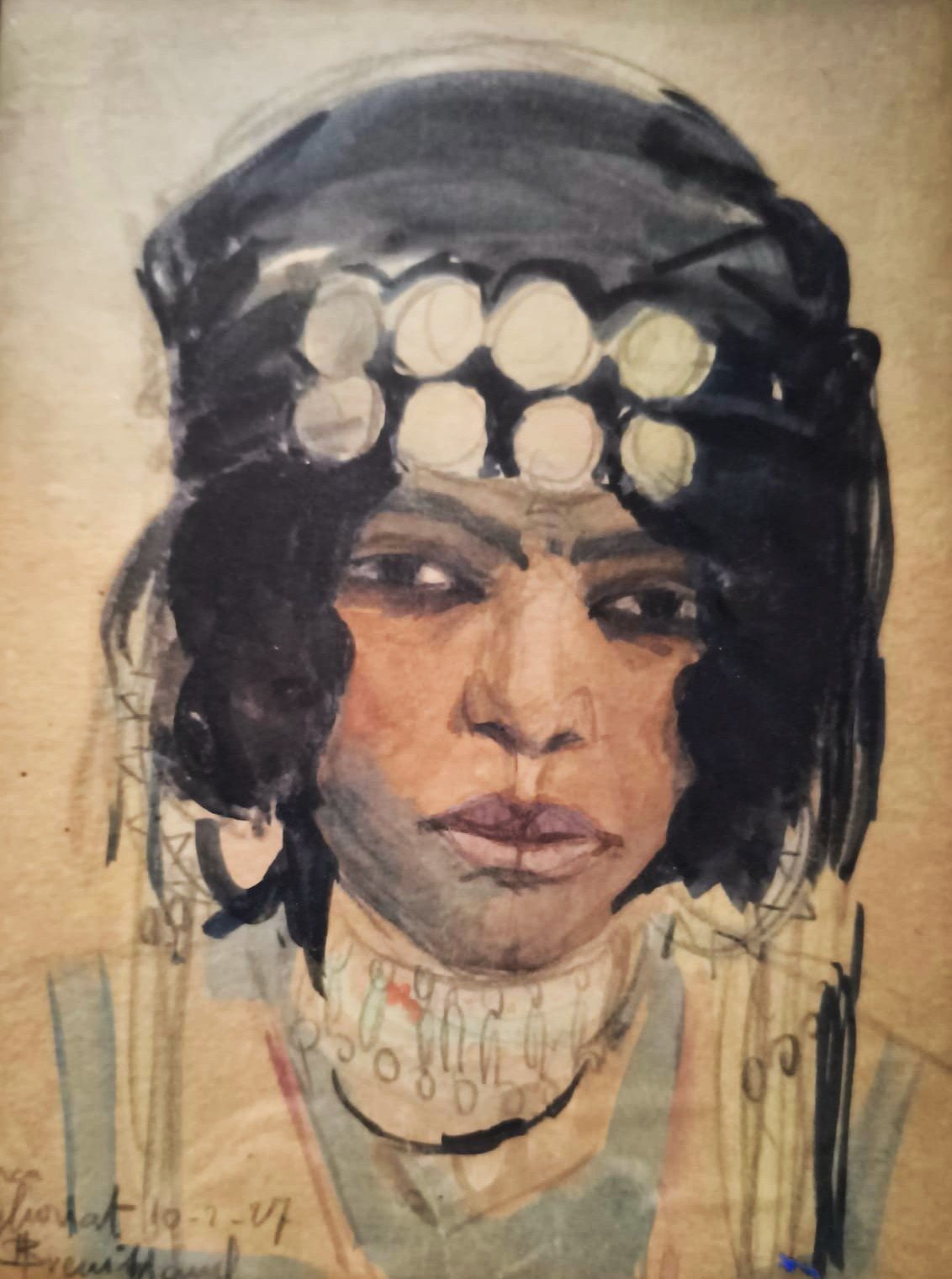
Dated 10 February 1927, this portrait of Mazilia belongs to the small group of female figures executed by André Breuillaud during the heart of the Montmartre period (ZM). By this date, the artist was no longer limiting himself to landscapes of wasteland, peripheral zones and urban fringes; he was also focusing his attention on encountered faces, individual presences and singular identities. The sitter's name, written on the sheet, gives the work strong documentary value: this is not an anonymous type, but a named individual, observed and recorded at a precise moment.
The work directly precedes another representation of Mazilia dated the following day, AB-ZM-1927-003, and belongs to the same group as AB-ZM-1927-004. These works testify to a concentrated, almost serial study of North African female figures treated without setting or anecdote. Breuillaud is less concerned with ethnographic description than with the density of a face, the tension of a gaze, and the way in which a few signs — hairstyle, adornment, tattoos or ornaments — can become vehicles for an inner presence.
Formal / stylistic description
The face occupies almost the entire height of the composition. It is presented frontally, slightly compressed by the dark mass of the hairstyle or veil, which forms a broad black arch above the forehead and strongly frames the temples. This shadowed area, handled in broad, velvety passages, gives the portrait a grave, almost sculptural foundation. Across the forehead, a row of pale discs introduces a horizontal rhythm that contrasts with the verticality of the face and immediately draws the eye toward the upper part of the composition.
The features are constructed with great economy. The eyes, dark and elongated, do not confront the viewer directly; instead, they seem to glance sideways, conveying an expression of restraint and silent defiance. The nose is modelled through concise planes, the closed lips rendered in violet-brown tones, while the cheeks combine ochres, pinks and greyed shadows. The neck and chest remain more sketch-like, crossed by light decorative signs, as though Breuillaud had reserved the full expressive intensity for the face itself.
The watercolour technique plays an essential role here. Unlike neighbouring watercolours that are more transparent and washed, this sheet seeks a matte substance, at times almost charcoal-like. The blacks do not merely define forms; they create an enveloping depth around the head. Yet the lighter highlights, warm flesh tones and linear notations retain considerable flexibility, preserving the immediacy of execution and the character of a study from life. The image remains open and unfinished in places, but this restraint enhances the portrait's concentrated power.
Comparative analysis / related works
Compared with AB-ZM-1927-003, depicting the same model on the following day, this work appears more frontal, darker and more condensed. The version of 11 February favours a three-quarter pose, a more introspective face and a fluid watercolour handling that softens transitions. AB-ZM-1927-005, by contrast, presents the figure as an immediate presence: the head is more firmly framed, the black mass of the hairstyle dominates the image, and the frontal ornament almost transforms the face into an icon.
Comparison with AB-ZM-1927-004 confirms this investigation of the face as a focal point of tension. Both portraits share an economy of setting, attention to forehead ornaments and a desire to capture a human presence without narrative excess. Yet where AB-ZM-1927-004 displays a sharper graphic intensity, AB-ZM-1927-005 distinguishes itself through denser handling and a more enveloping chiaroscuro.
The work therefore occupies an important place within the ZM portrait group of 1927. It shows Breuillaud at a moment when his interest in social margins was shifting toward a more direct attention to individuals. The figure is neither folklorised nor transformed into a simple exotic motif; instead, it becomes a field of formal and psychological observation in which line, colour and material seek to render a singular presence perceptible.
Justification of dating and attribution
The date of 10 February 1927 is inscribed on the work itself and provides a precise point of reference. It is entirely consistent with the group of portraits devoted to Mazilia and with the stylistic climate of the ZM period: tight framing, rapid execution, emphasis on the face, and the combination of nervous drawing with highly synthetic masses of colour.
The attribution to André Breuillaud is supported by the signature, by the coherence of the subject with the dated sheets of February 1927, and by the pictorial treatment itself: economy of setting, intensity of gaze, construction through strong contrasts and the freedom of the medium on paper. The work usefully complements the corpus of Mazilia portraits by providing a version that is more frontal, denser and darker than the related examples.
Provenance / exhibitions / publications
Private collection.
© Bruno Restout - Catalogue raisonné André Breuillaud